
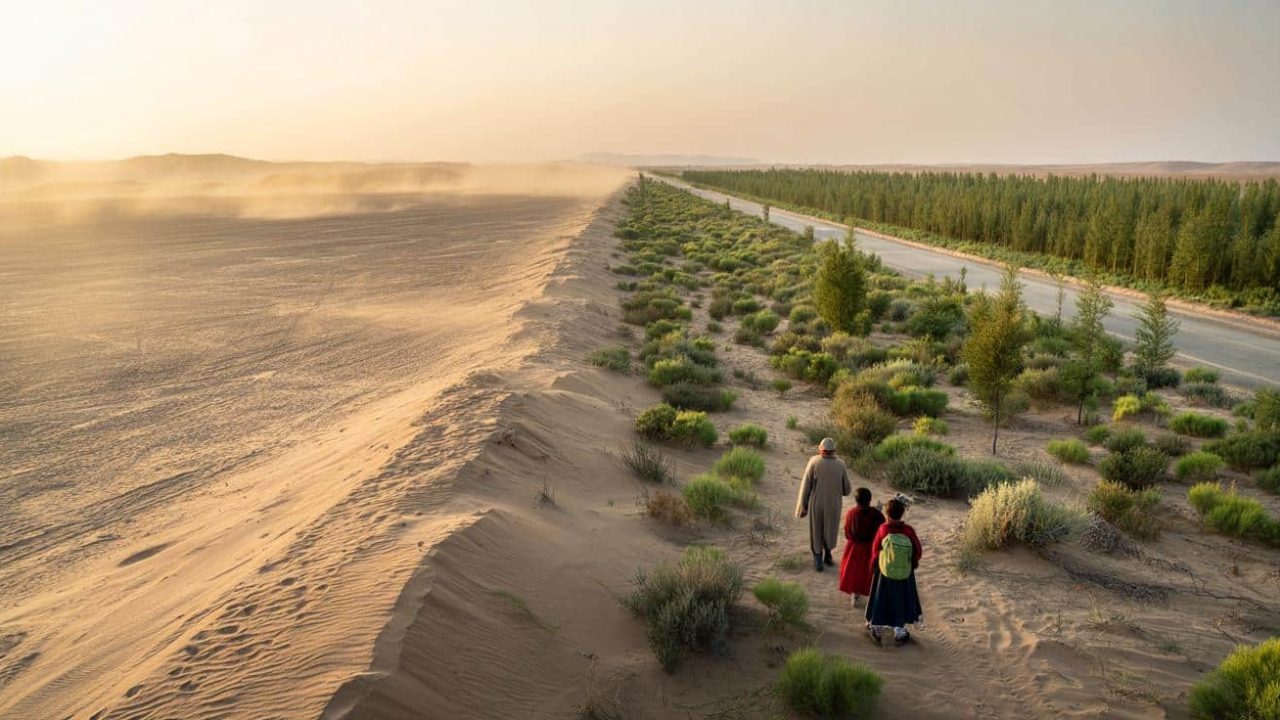
Eighty-year-old Chen Weiming still remembers the dust storms that would sweep through his village in northern China during the 1980s. “The sand would pile up against our doors like snow,” he recalls, squinting at the horizon where green trees now stand. “My wife would hang wet sheets over the windows, but the dust always found a way in.”
Today, Chen tends a small orchard where desert once crept toward his home. The transformation didn’t happen overnight – it took decades of the most ambitious tree-planting campaign in human history.
What Chen witnessed is part of China’s extraordinary billion-tree planting effort that has fundamentally changed the country’s relationship with its expanding deserts. Since the 1990s, this massive environmental project has not only slowed desertification but created entirely new ecosystems across northern China.
The Great Green Wall Takes Shape
China’s tree-planting initiative, officially known as the Three-North Shelter Forest Program, launched in 1978 with an audacious goal: plant trees across 4,480 kilometers of northern China to halt desert expansion. The program targets completion by 2050, making it the longest-running ecological restoration project on Earth.
The numbers are staggering. Since the 1990s alone, China has planted over 66 billion trees across an area larger than Germany. This green belt now stretches from the western deserts of Xinjiang to the northeastern forests of Heilongjiang province.
We’re not just planting trees – we’re rebuilding entire landscapes that were lost to human activity and climate pressures over centuries.
— Dr. Liu Shirong, Chinese Academy of Forestry
The scale becomes clearer when you consider that China now plants more trees annually than the rest of the world combined. Satellite imagery shows dramatic changes: areas that appeared brown and barren in 1990s photos now display patches and corridors of green.
But this isn’t just about numbers. The strategic placement of these forests creates barriers that physically block sand and dust storms while stabilizing soil with deep root systems.
How the Program Actually Works
China’s approach combines government coordination with local community involvement. Here’s how the massive undertaking operates:
- Species Selection: Drought-resistant trees like poplar, pine, and desert shrubs chosen for each region’s climate
- Community Participation: Local farmers receive payment and land-use rights for maintaining planted areas
- Technology Integration: Satellite monitoring tracks survival rates and identifies areas needing replanting
- Water Management: Drip irrigation and water-harvesting techniques support young trees in arid regions
- Economic Incentives: Fruit trees and timber species provide income sources for participating communities
| Decade | Trees Planted (Billions) | Area Covered (Million Hectares) | Desert Expansion Rate |
|---|---|---|---|
| 1990s | 15.2 | 8.3 | 2,460 km²/year |
| 2000s | 22.8 | 12.7 | 1,283 km²/year |
| 2010s | 28.4 | 16.2 | 242 km²/year |
The data reveals the program’s accelerating impact. Desert expansion has slowed by over 90% compared to pre-1990s rates, while forest coverage in northern China has doubled.
What impressed me most wasn’t the scale, but seeing former desert farmers now harvesting apples and walnuts from trees they planted twenty years ago.
— Dr. Sarah Chen, International Forestry Research Institute
Real Changes People Can See and Feel
The environmental improvements extend far beyond stopping sand dunes. Air quality in Beijing and other northern cities has improved partly due to reduced dust storms. The frequency of severe dust events dropped from 23 per year in the 1990s to just 4 per year in recent decades.
Water retention has improved dramatically in planted areas. Tree roots help soil absorb and hold rainwater, reducing both flooding during wet seasons and drought stress during dry periods.
Wildlife has returned to regions where it hadn’t been seen for generations. Camera traps now document deer, wild boar, and various bird species in forests that didn’t exist thirty years ago.
My children have never experienced the dust storms I grew up with. They think trees have always grown here.
— Wang Xiaoli, farmer in Inner Mongolia
Local economies have transformed as well. Many communities now earn more from sustainable forestry, fruit production, and eco-tourism than they ever did from traditional farming on marginal desert-edge land.
The carbon storage benefits are substantial too. These new forests absorb an estimated 1.18 billion tons of CO2 – equivalent to taking 250 million cars off the road permanently.
Challenges That Still Need Solutions
Despite remarkable successes, the program faces ongoing obstacles. Survival rates vary significantly by region, with some areas seeing 30-40% of planted trees die within five years due to drought or poor soil conditions.
Monoculture planting in early phases created forests vulnerable to disease and pests. Recent efforts focus more on diverse, native species that create resilient ecosystems rather than simple tree farms.
Water usage remains controversial. Critics argue that water-intensive tree species in arid regions compete with human needs and natural desert ecosystems that have their own ecological value.
The key is finding the right balance – stopping harmful desertification without trying to turn every desert into a forest.
— Professor Zhang Ming, Beijing University Environmental Sciences
Climate change adds complexity, as shifting precipitation patterns affect which species will thrive in planted areas over coming decades.
Yet the overall trajectory remains positive. China’s billion-tree effort proves that massive environmental restoration is possible with sustained commitment and community engagement. Other countries facing desertification, from India to several African nations, are adapting similar approaches to their own landscapes.
For Chen Weiming, watching his grandchildren play under fruit trees where dust storms once raged, the transformation feels almost miraculous. “Sometimes I forget how bad it used to be,” he says. “Then I look at old photos and remember why we needed to change.”
FAQs
How many trees has China actually planted since the 1990s?
China has planted over 66 billion trees since the 1990s as part of its Three-North Shelter Forest Program, covering an area larger than Germany.
Has the tree planting actually stopped desert expansion?
Yes, desert expansion in northern China has slowed by over 90% compared to pre-1990s rates, dropping from 2,460 km² per year to just 242 km² per year.
What types of trees does China plant in desert areas?
China primarily uses drought-resistant species like poplar, pine, and native desert shrubs, along with fruit trees that provide income for local communities.
Do the planted trees actually survive in harsh desert conditions?
Survival rates vary by region, typically ranging from 60-70% after five years, with newer planting techniques and species selection improving success rates.
How does this affect air quality in Chinese cities?
The tree barriers have significantly reduced dust storms affecting northern Chinese cities, with severe dust events in Beijing dropping from 23 per year to just 4 per year.
Are other countries copying China’s approach?
Yes, countries including India, Pakistan, and several African nations have launched similar large-scale tree planting programs to combat desertification in their regions.